FFS LinkedIn!
If I follow Alicia Teltz’s advice to succeed on LinkedIn, my profile must reflect only relevant experience, or my reach will tank. (Watch her video; it’s eye-opening.)
The new version [algorithm] is more like a “For You Page”: it looks at who you are, what you post about, and what you engage with, then groups you into a “persona bubble” and shows your content to people in that bubble.
IMHO, my profile shows that I know a thing or two about hiring, recruitment, candidate experience, and so on. You know, a few recruitment books, workshops for talent acquisition and recruiters, and a global speaker at HR/TA events, etc. Heck, I’ve even been frequently quoted as a recruitment expert in the press.
I also comment on posts of people working in TA or recruitment, seeing as that’s who is in the network I’ve built over the last 17 or so years.
Yet, when I post something educational or helpful for recruiters, it receives few views.
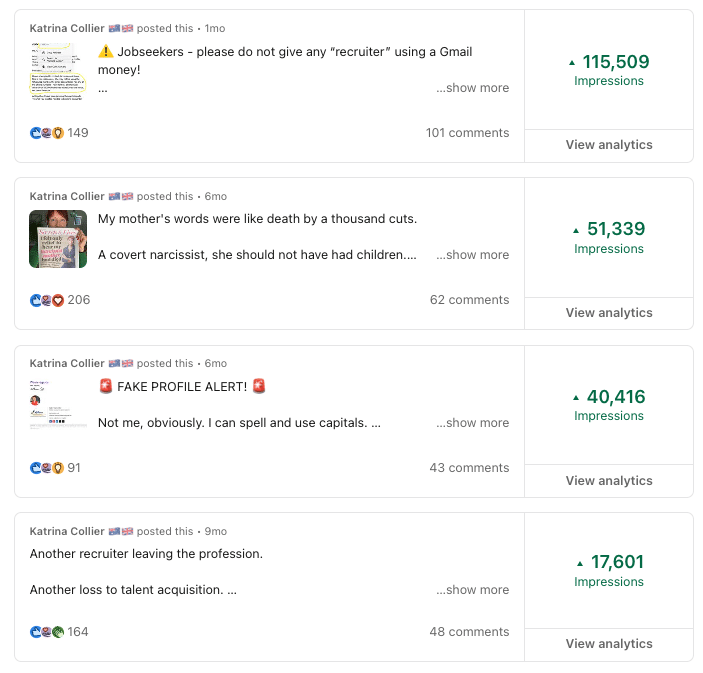
But a post about someone using my name to scam job seekers garners 115,505 impressions. Indeed, my highest-performing posts over the last 12 months had nothing to do with my professional experience. (Super grateful for the second highest one though!)
Of course, it doesn’t help that I refuse to play LinkedIn’s games and chase impressions.
In fact, other than writing this newsletter occasionally, I doubt I’ll bother posting. Because I have better things to do with my irreplaceable time. Like write another book or share a ranty reel on Instagram and TikTok. 😆
Binary vs multifaceted
According to Alicia, rather than show your post to people who chose to follow you, LinkedIn shows the post to people who have expressed an interest in the topic.
You know when you like a post on one topic, and then that’s allllllll you see? When really, you were just being human; like when I chatted about cars with my recruiter mate, Mark Hopkins.
The latest algorithm seems to want us to be binary.
A member speaking only about their professional area of expertise.
But humans are not like that.
LinkedIn, I am multifaceted.
- I am an Aussie Brit; a former Sydneysider now a Londoner.
- Two dogs own me, and my life revolves around their schedule.
- I am a Gemini (with a Cancer moon and Leo rising 😵💫).
- I know a lot about recruiting and have lived experience healing complex trauma.
- I am grounded and practical, yet clairaudient and spiritual.
- I am an author and speaker, and a DIY queen.
- Oh, and I have a new petrol hybrid car, right Mark? And find driving an auto dull! 😆
I talk about healing childhood trauma because I gained extensive skills that I use in my professional work! Like boundary setting, which every recruiter I have ever met needs to use. And healing perfectionism and people-pleasing, because way too many in HR and TA need to quit that! And so on. My personal and professional life are intricately entwined.
Is it so wrong for multifaceted people to want to be their complex, perfectly imperfect selves, and write what they want? Isn’t that what creates true human connection?
Isn’t the point of having built a professional network on LinkedIn so that you can talk about what you want and for it to appear in the feed of the people who chose to follow you? Isn’t that the point of following people? Isn’t that human realness what creates business relationships? Aren’t we past the ‘that belongs on Facebook’ era?
But no, it seems, LinkedIn’s algorithm doesn’t want users to be complex.
The professional network has, once again, lost its way.
I, for one, can’t be arsed anymore.
I’m far from alone.
Plus, the AI slop reporting button just might be the final nail in LinkedIn’s active user base.
P.S. Like my certified human-authored books, the planet wasn’t harmed in the writing of this article. I used my brain all by itself, so step away from the AI-slop button. 😉