AI Slop (Slopaganda) Needs Confident Counter Opinions
It’s easy to think that someone known for being vocal and grounded, sharing her opinions in 3 books and speaking on 6 continents, has always been this confident.
You’d be wrong.
As a survivor, I fight for the underdog – like poorly treated candidates – but before I healed my wounds, I was forceful, fiery, defensive, and alienated many. A highly sensitive person ruled by complex PTSD, I was emotionally dysregulated, had exceptionally low self-worth and difficulties with all manner of relationships, including professional. Just ask some of my former bosses! 🫣
In the last newsletter, I wrote about Critical Thinking, which knowledge workers need more than ever, now and in the future, due to the increase in slopaganda.
In it, I confessed that before the self-work, I did not have the required “self-directed, self-disciplined, self-monitored, and self-corrective thinking”, the capacity for “effective communication”, or even, if I am truly honest, a “commitment to overcoming our native egocentrism and sociocentrism,” that makes someone great at thinking critically.
The rise in slopaganda – propaganda that’s AI-powered and unprecedented in terms of speed, scale, audience reach and persuasiveness – requires people to “make clear, reasoned judgements based on interpreting, understanding, applying and synthesising evidence gathered from observation, reading and experimentation.“
But if we lack the confidence to deliver the judgement, we are scuppered before we begin.
Being heard
It’s one thing to have an opinion, and something else altogether for it to be well received, especially up against slopaganda!
In times like these, where factual, relevant, and, dare I say it, sane opinions can be torn to shreds, gaslit, or even lead to online bullying or shadow bans, many choose silence. I get it, recently I’ve deleted post comments when people became personally insulting, rather than curious about my differing opinion. Recently, a neighbour even screamed at me in the street and now, rather amusingly, actively avoids me because he believes political slopaganda.
However, their triggered behaviour is familiar. Once, I behaved similarly. My ears were closed to an alternative opinion; defensive, I shouted others down.
Today, after years invested in healing, I acknowledge and curiously probe an unexpectedly hostile reaction and what I could have done differently. One of the greatest gifts of the self-work, which I’ve detailed in The Damage of Words, was losing my defensiveness and compassionately learning how to consider a situation and others’ opinions from all angles.
Last weekend, I wrote a well-intended but poorly timed comment on a post. It triggered a reader who swiftly insulted my credibility and tone. Rather than argue with a stranger, I deleted my comment before I even finished reading her tirade. I allowed myself to feel upset, reassured my inner child that all was well, and became curious about this woman’s reaction.
Ultimately, I realised that I’d rushed in without noticing that people were already upset. Next time, I will take a moment to read the room, no matter how strongly I feel about the subject!
Confidence
Gaining the confidence to deliver a public opinion has been a journey. Would you believe that:
- The first time I spoke in front of a conference audience, I shook like a leaf and clung to the podium for dear life, unaware of what I was saying as adrenaline surged.
- When I submitted the final draft of The Robot-Proof Recruiter, I ugly cried for over an hour. My inner child was fearful of your feedback and feeling the rawness that comes from laying out my opinion for readers to critique. Fear of rejection and criticism ruled my behaviour for too many decades.
- Publishing The Damage of Words last year, I felt like I was running down the road naked as I shared my deeply personal healing and spiritual journey to inspire others to face their old emotional wounds.
But each step I took outside of my comfort zone, whether big like these or small, gave me tools to use when ego becomes loud, and my confidence shakes.
Evidence to the contrary
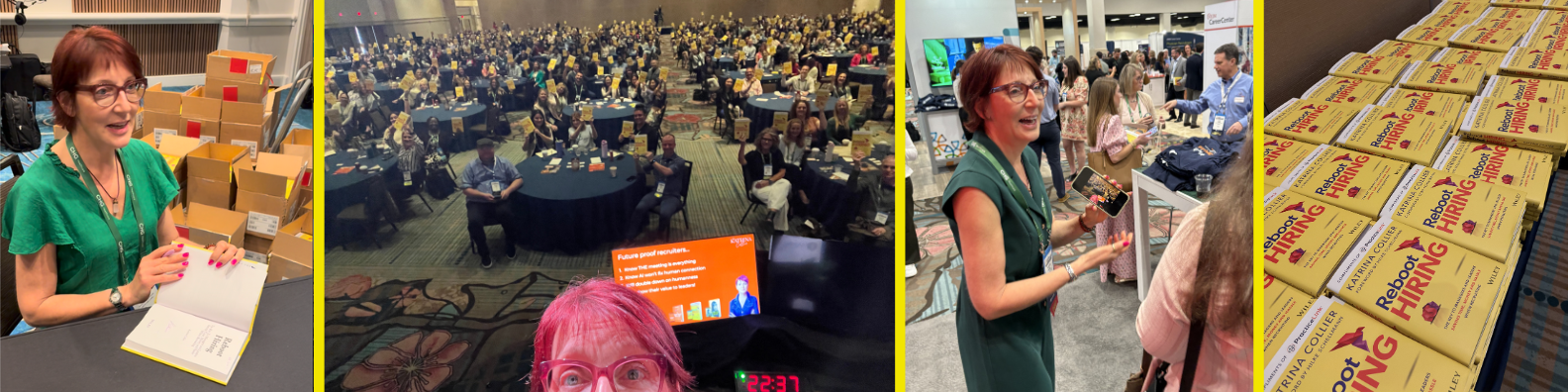
Last week, 14 years and 6 continents after that first talk, I delivered the opening keynote to 650 physician and APP recruiters at AAPPR in Orlando, Florida, USA, thanks to the kindness of PracticeLink. One of only two keynotes, it was a big deal, and I was thrilled to be invited!
Then two things happened that raised the volume of my negative inner critic (ego)
- I was to be introduced by Free Deps, the warm-up act, local freelance rappers!
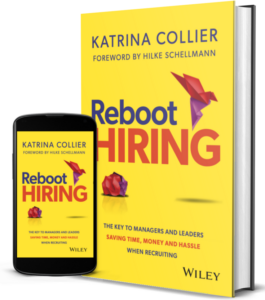
- We agreed that I would take a selfie from the stage to show off the Practicelink-branded copies of Reboot Hiring, which each attendee received.
Inner chatter in overdrive: how on Earth will I maintain that high energy with a talk about hiring? And ugh, though I love being on stage, asking for a selfie is outside my Gen-X comfort zone. (I’m the kind of person who would have just watched Madonna at Coachella.)
I silently responded to my inner critic as I stood in a power pose waiting to start. I reminded ego of how far I have come, all the times I have effortlessly delivered a keynote, and that this intro is simply another step on the road. Receiving evidence to the contrary, it briefly hushed.
Mid flow, it piped up again. ‘You don’t know what you’re talking about!’ it wailed in a confidence-reducing manner. Silently, I countered, ‘They’re not in their phones! If this didn’t resonate, they’d be looking down or walking out. I see a sea of faces.’
Has similar happened to you? Is this a familiar dialogue? Many might call this impostor syndrome; I call it a momentary test of confidence.
As I am drawing to a close, I remember the selfie. Ugh, I think again. How can I possibly ask for this? (Contrary to assumptions, I’m not an extrovert!) With a deep breath, I ignored the little voice. In seconds, their books were held up, and laughter crackled across the room as I struggled to take a selfie! 😆
Next time, I’ll try to ask for the stage lights to be dimmed and the auditorium lights raised! 🫣
Knowledge workers already need to be able to sort slopaganda from fact and confidently argue the case for truth. Hopefully, by sharing my inner dialogue and moments of doubt, it’ll help you feel more confident when facing someone who “seems” to have it all together.
You won’t always get it right when pushing back and offering a different point of view; some people, like my neighbour, will never be open to it, no matter how it’s delivered.
So remember, if it goes pear-shaped, avoid becoming defensive, and instead become playfully curious, because what your reflection reveals will help the next time you try.
I am Katrina Collier, uniquely combining over two decades in the recruitment profession with my lived experience healing trauma, to fix human connection. Based in London, UK, I am the author of 3 books: The Robot-Proof Recruiter, Reboot Hiring, and my memoir, The Damage of Words, a popular 6-continent keynote speaker, and deliver workshops that future-proof talent acquisition teams, amongst other things!